

83815 Corvette Rack And Pinion1955-1962 Power Paintable Column
Steeroids, Speed Direct, 83815
Bolting on this kit will make a significant improvement in the overall drivability and responsiveness of your car.
Take Control of your Classic!!
The first thing you will notice is the quicker ratio. Stock ratios usually yield between 3.5 or 4 turns lock to lock. That’s pretty slow.
IMPORTANT THIS IS A PAINTABLE STEERING COLUMN KIT !!
The kit comes complete with everything you need for installation. A power steering pump is included but you can use your stock pump. An interesting note, you can run the system without any power assist. Just leave the plugs in the in/out ports.
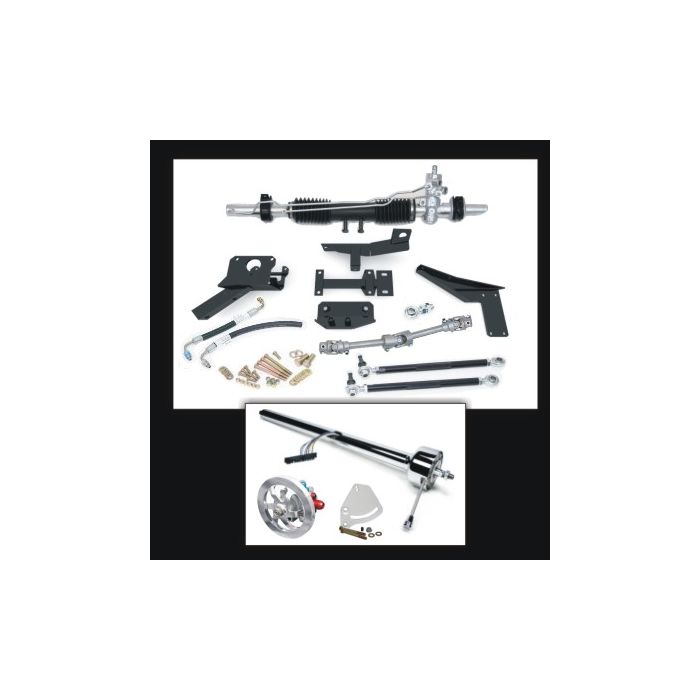
If you really want a precise steering setup, a power rack and pinion offers a 30-year leap forward in steering technology for your Chevy.
Nearly all new cars come equipped with rack and pinion steering. Most people have grown accustom to the feel of it because they drive modern cars to work every day. When you take the fun Chevy out for the weekend you are suddenly and quite literally placed in the 1960’s when steering was as vague as gas prices (nobody was very concerned about either).
Even with all new components, do you find yourself sawing the wheel back and forth a little to keep it on the road? Do you find that in the corners you have to chase the car to hold the line you want?Bolting on this kit will make a significant improvement in the overall drivability and responsiveness of your car. The first thing you will notice is the quicker ratio. Stock ratios usually yield between 3.5 or 4 turns lock to lock. That’s pretty slow. Autocrossing or just fast, mountain road driving becomes a chore with those ratios.
Our rack yields about 2.75 turns lock to lock. Once you get used to the responsiveness of the steering you will notice that your car now drives exactly where you point it. Roll into a long sweeping corner and the steering wheel can be held in one position. No more of the constant adjustments just to keep the car in the lane. Suddenly your car is driving like a new car and I don’t mean when your car was new. I mean it drives like a 2000 model year car! (At least it steers like one, it won’t fix your stumbling carb or your soft brake pedal).
The kit comes complete with everything you need for installation. A power steering pump is included but you can use your stock pump. An interesting note, you can run the system without any power assist. Just leave the plugs in the in/out ports. Steering effort is about the same as the stock manual steering box.
Installation is a straightforward process using simple hand tools. The only special tool you need is a pickle fork to remove the tie rods for the steering arm. The whole project takes 3 to 5 hours to complete.
BEARING BRACE, C1 - Rev C 1
Parts
DRIVERS SIDE BKT, C1 Rev. B 1
Parts
PASSENGER SID BKT, C1 REV B 1
Parts
RADIATOR SUPPORT, C1 1
Parts
TIE ROD BKT, C1 - REV C 1
Corvette 55-62
HOSE, braided rack set 1
Corvette 55-62
HOSE, braided reservoir supply to pump 1
Tie Rods and Tie Rod Ends
TIE ROD SLEEVE ASSY; 53-62 VETTE 18.5 IN 1
U-Joints from Borgeson
U-JOINT, ASSY 53-62 COR - ALUMINUM 1
Tie Rods and Tie Rod Ends More Info
Kit, Tie Rod Ends 1
Tie Rods and Tie Rod Ends
ROD END ASSY - 1 Rack & Pinion Units
R & P, POWER - 2.5 TURN 4517P NO CLAMPS 1
Rack Mounting Brackets
CLAMP, CORVETTE & MUSTANG, DRIVERS Rack Mounting Brackets
CLAMP, CORVETTE & MUSTANG, PASSENGER 1
Power Steering Pulleys
PULLEY, 5 INCH, 1 GROOVE TYPE II ALUM 1
Power Steering Pumps
PUMP, 53-62 CORVETTE- AL type II/TC 1
Power Steering Pumps
PUMP BRACKET - 53-62 CORVETTE 1
55-68 Corvette Steering Columns More Info
COLUMN 53-57 CORVETTE STEEL UNPAINTED 1
55-68 Corvette Steering Columns More Info
Column Wiring Kit, 53-62 Corvette 1
55-68 Corvette Steering Columns More Info
Steering Wheel Adptr, 53-62 Vette Polish 1
Parts
RESERVOIR - 53-62 CORVETTE 1
Other Components
INFO PACKET; 53-62 CORVETTE 1
Hardware And Fasteners More Info
KIT, METRIC RACK BOLTS WITH LOCK please allow aproximately 4-6 weeks to assemble and ship do to a high volume of buisness.
| year make model | corvette 1955 - 1962 Power Rack Paintable Column 83815 |
|---|---|
| Manufacturer | STEEROIDS |
| More Info | Autocrossing or just fast, mountain road driving becomes a chore with those ratios.Our roadrace kit yields about 2.75 turns lock to lock. Once you get used to the responsiveness of the steering you will notice that your car now drives exactly where you point it. Roll into a long sweeping corner and the steering wheel can be held in one position. No more of the constant adjustments just to keep the car in the lane. Suddenly your car is driving like a new car and I don’t mean when your car was new. I mean it drives like a 2000 model year car! (At least it steers like one, it won’t fix your stumbling carb or your soft brake pedal). The kit comes complete with everything you need for installation. A power steering pump is included but you can use your stock pump. An interesting note, you can run the system without any power assist. Just leave the plugs in the in/out ports. Steering effort is about the same as the stock manual steering box. Installation is a straightforward process using simple hand tools. The only special tool you need is a pickle fork to remove the tie rods for the steering arm. The whole project takes 3 to 5 hours to complete Steroids FAQsWhy rack & pinion vs. steering box?It is a common concern if the brackets made for any steering conversion kit are strong enough to handle the appropriate loads. Steeroids rack and pinion kits have steel mounting brackets that are designed to handle loads encountered in normal use with a set of wide tires, while turning when the car is at rest (the highest load case). Over the years we have increased the strength of the brackets to the point that the frame rails will actually flex before our brackets do! These brackets are stress tested both in our development facility with sensitive deflection tools and out on the race track where we try our hardest to punish these parts to the extreme. In fact, we once received some photos of our kit on a customer’s race car after he slid the car off the race track into a curb at a high rate of speed. He did significant damage to the front of the car, but NONE of the Steeroids brackets broke. The rack and all of the brackets were bent severely, but everything was still in tact. We were very pleased… With years of experience and testing, plus thousands of these kits on the road from street cruisers to racers, you can be confident that a Steeroids rack and pinion kit will be durable and rugged enough to handle whatever driving style you throw at it. Power Steering Pumps*Pump 1 Our power racks have standard limits for power steering pumps, however Steeroids WILL work with all stock power steering pumps. If you have an aftermarket pump that you are considering using with our kit, please refer to the following information: The pump cannot have a max pressure exceeding 1250-1300 lbs. The pump cannot have a max volume exceeding 2 gallons per minute UNLESS you have a system (such as Hydroboost braking systems) that includes an additional amount of fluid over the stock amount. Why? If you run just from the pump to the rack, then back to the pump, excessive heat is the enemy. Any more than 2 gallons per minute could damage the rack. Systems with additional fluid and routing allow the fluid to cool, allowing some pumps with higher outputs. Unfortunately, higher output pumps may result in slightly less resistance in the steering wheel. This, of course, is a matter of preference for the driver. Fluid Please do not run synthetic fluid through your rack unit until the break-in period is over, usually around 1000 miles. If you are looking for more road feel (or greater resistance in the steering wheel), chances are your suspension is what needs to be adjusted – not your pump. Caster, camber and alignment have more to do with the steering wheel resistance than pump pressures for the most part. Please refer to the recommended settings below before adjusting your pump. If, after trying these settings, you still do not have enough resistance in the wheel, you can try a pressure reducing kit. Please call for more information on pressure reducing kits. Toe (total) – 0 to 1/8″ (increase from 0 for greater stability) Camber – 0 to negative .25 degrees Caster – 3 to 6 degrees positive (add as much positive caster as possible) The pumps that we offer have all new interior parts. The housing is a refurbished non-wearable part. Diagnosing Power Steering Problems When trying to determine what is causing a problem in your power steering, keep this in mind. If the problem occurs only in one direction, the problem is probably in the box or rack. If the problem is in both directions, it is most likely the pump, dirty fluid or hoses. Be sure there are no kinks or obstructions in your power steering hoses. Dirty Steering System Before changing any single component of the steering system, inspect the cleanliness of your system. Dirty or black fluid can quickly ruin new steering components. If changing the box or rack, rub your finger on the inside of the reservoir. If it isn’t clean, you must flush the pump and hoses with clean fluid before installing new components. Bleeding Power Steering All power steering systems are designed to be self-bleeding, but sometimes they need a little help. After installing new components, fill the reservoir and let it sit for a few minutes. Raise the front end of the vehicle and turn the wheels back and forth slowly with the engine off to allow the steering box to draw fluid. Keep the reservoir full. When the fluid level stops dropping, start the vehicle and continue turning the wheels. When the fluid level remains constant the system is fully bled. Put cardboard under the front tires while testing your steering system. The cardboard will slide on the floor and prevent wearing flat spots on the tire from excessive turning of the wheels while not moving. Important Note: All GM power steering pumps generate approximately 1,000 to 1,200 PSI of line pressure. This is compatible with GM steering boxes and GM rack and pinion units. If these pumps are used with a Mustang II rack and pinion, the steering will feel too sensitive on the highway. This can be corrected by adjusting the pump’s flow control valve to generate the proper pressure for the Mustang rack. What About Bracket Strength & Flexing?*Steering Wheel After you have installed the Steeroids rack and pinion kit, there should not be any ‘Play’ in the steering wheel. This is also referred to as a ‘Dead Zone’ and it takes place when you turn your steering wheel back and forth a slight amount and there is no resistance – the wheels and tires are not responding. This can cause the car to be unresponsive and is a dangerous condition. Usually, people automatically think there is something wrong with the rack unit itself, but the rack is VERY seldom the problem. If you are encountering ‘Play’ in the steering wheel with our kit, follow the steps below. It might be easiest to have another person help you at first. While the engine is off, have one person turn the wheel back and forth a little bit – but only turn it within the ‘Dead Zone’, not all the way back and forth through the whole travel of the rack. Have another person carefully look through the entire system while this is happening. Usually you will see a place where motion is happening on one end of a component but not on the other. This is a good place to start. Even if you find a problem, it is a good idea to check all of the suggestions below:
NOTES: You will notice that the center tie rod bracket moves on the rack unit. As outlined in the installation instructions, this is normal. On Corvette Steeroids kits it is acceptable to have a slight amount of play where the intermediate shaft passes through the support bearing. But it should not be flopping around. What About Bracket Strength & Flexing?It is a common concern if the brackets made for any steering conversion kit are strong enough to handle the appropriate loads. Steeroids rack and pinion kits have steel mounting brackets that are designed to handle loads encountered in normal use with a set of wide tires while turning when the car is at rest (the highest load case). Over the years we have increased the strength of the brackets to the point that the frame rails will flex before our brackets do! These brackets are stress-tested both in our development facility with sensitive deflection tools and out on the race track where we try our hardest to punish these parts to the extreme. We once received some photos of our kit on a customer’s race car after he slid the car off the race track into a curb at a high rate of speed. He did significant damage to the front of the car, but NONE of the Steeroids brackets broke. The rack and all of the brackets were bent severely, but everything was still intact. We were very pleased… With years of experience and testing, plus thousands of these kits on the road from street cruisers to racers, you can be confident that a Steeroids rack and pinion kit will be durable and rugged enough to handle whatever driving style you throw at it. An Interesting Side Note: We recently learned that one of our competitors was boasting that their kit was using stronger, heavier duty material for the brackets than the Steeroids kits. Upon further research it was determined that they are using the SAME material thickness that we are! What About Bump Steer?What’s with all of this talk about bump steer, and why is it so important? This is a subject that not a lot of people really understand, so people don’t think it is that important. It is if you want to enjoy driving your classic. Bump steer occurs when a vehicle is moving over rough or uneven surfaces. As the suspension travels up and down, if the tie rods on the steering unit are not traveling at exactly the same radius as the suspension, it will cause the car to toe in and toe out as the suspension travels. Because the alignment of the car is changing over rough surfaces the car becomes very darty and wanders. This in not fun and can become dangerous in many situations. All Steeroids rack and pinion kits include adjustable tie rod ends so that you can make sure the tie rods are parallel with the lower control arms, ensuring they travel the same radius as the suspension. This keeps the car’s alignment where it needs to be over all surfaces, making your car not only steer better but actually making it fun to drive! Steeroids and Steering FeelAddressing the Steering Feel with Steeroids Kits Many factors can affect the way the steering feels. Many words can describe how the feel is, but this section is mostly covering how much resistance there is in the steering wheel. If you have play, or a dead spot where there is no response at the wheels when rotating the steering wheel, go back to the Steeroids – Addressing Play in the Wheel section. This section talks about the amount of resistance or the amount of effort that is required to turn the steering wheel. Again, there are several factors to consider, so please read carefully. Pump Pressure & Volume All of the Steeroids rack and pinion conversion kits are designed to work with the stock power steering pump. More questions arise when people are not using the stock power steering pump, or their stock pump has been rebuilt. Our racks can handle anywhere from 800-1400 psi. Usually the higher the pressure the pump puts out, the easier it is to turn the steering wheel (less resistance). If you have lower pressure there is usually more resistance in the steering wheel. We prefer running in the 900-1200 range, but that is also up to the driver’s personal preference and the alignment settings (more caster = more resistance in the steering wheel). If you have a stock pump that has been rebuilt and is putting out more pressure than desired, we do offer pressure reduction kits for GM Saginaw pumps. The pump cannot have a max volume exceeding 2 gallons per minute UNLESS you have a system (such as Hydroboost braking systems) that includes an additional amount of fluid over the stock amount. Why? If you run just from the pump to the rack, then back to the pump, excessive heat is the enemy. Any more than 2 gallons per minute could damage the rack. Systems with additional fluid and routing allow the fluid to cool, allowing some pumps with higher outputs. Unfortunately, higher output pumps may result in slightly less resistance in the steering wheel. This, of course, is a matter of preference for the driver. Steering Feel Too Sensitive Steering feel can be described in two different ways, so the main thing we need to do is determine what “too sensitive” means, and then work to fix it. Please see the two different instances below:
Alignment is the first thing to check. If the alignment has been set to our recommendations and the wheel still does not have the resistance required, it can be caused by remanufactured power steering pumps putting out more pressure than preferred for the rack unit. Reducing pump pressure to about 900-1000psi will help increase the resistance in the steering wheel. If you have a GM Saginaw pump we have pressure reduction kits that you can use to lower the pressure on your pump just click here.
Steering Feel Too Hard Begin buy determining when the steering effort is heavy. If you increase the rpm from idle to about 1500 rpm does the power assist work? Is the steering effort too heavy all the time, regardless of engine speed or vehicle speed? Is there any associated power steering pump noises such as groaning or whining? If the lack of power assist is only at idle then the your options are to:
What About Header and Oil Pan Clearance?Steeroids rack and pinion kits clear most aftermarket headers and oil pans. But there are some that do not work, and we try to keep track of all of them out there that might cause problems. To view header information, go into the tech support section for your vehicle and look in the link titled Exhaust / Header Clearances. What are the Power Steering Pumps & Pressure Requirements?All of the Steeroids rack and pinion conversion kits are designed to work with the stock power steering pump. More questions arise when people are not using the stock power steering pump, or their stock pump has been rebuilt. Our racks can handle anywhere from 800-1400 psi. Usually, the higher the pressure the pump puts out, the easier it is to turn the steering wheel (less resistance). If you have lower pressure there is usually more resistance in the steering wheel. We prefer running in the 900-1200 range, but that is also up to the driver’s personal preference and the alignment settings (more caster = more resistance in the steering wheel). If you have a stock pump that has been rebuilt and is putting out more pressure than desired, we do offer pressure reduction kits for GM Saginaw pumps. Steeroids Rack and Pinion Racks UsedOur Racks Steeroids rack and pinion steering conversion kits utilize remanufactured rack and pinion units. All of these racks are sand blasted and repainted, have new boots, seals and internal parts and then bench tested to make sure everything is working like new. Rack units do not have many wearable parts – and all parts that are wearable are replaced with new parts so that you can be sure you will have a rack that works. Though these racks may have some external blemishes, you can rest assured that the internals are new and bench tested before they ship out. We opted to go with refurbished rack and pinion units for several reasons, but mainly because:
Turning Radius: With SOME of the Steeroids rack and pinion kits, there is a slight loss in turning radius from the stock, but most of our customers have told us it is an insignificant amount. Navigating parking spots is not a problem with our kit. You can expect to gain about 6 feet when measuring the full diameter. Running Power Kits Manually We do not recommend running the power racks manually. You can do it to move it around a shop, but we do not recommend driving them this way. There is a chance residual fluid can remain inside of the rack and clog the valves causing what is called a pressure lock, where the steering wheel locks up under quick rotations of the steering wheel. Fluid We do not recommend synthetic fluid in the rack unit until the break-in period is over, usually around 1000 miles. Why do the steering U-Joints bind sometimes?U-joint binding is a question that commonly comes up. Is it hard to properly adjust the u-joints so that they are smooth and do not bind? Steeroids kits have continuously improved over the years to ensure that adjusting the U-joint assembly is an easy, straight forward task. Over the last few years, we have redesigned the mounting brackets to allow for more adjustment for the u-joint assembly to prevent binding. We have also improved our installation instructions so that there are photos and numerous different methods to achieve proper adjustment. And once everything is properly adjusted, the u-joints should last the life of the car! |