

Dakota Digital STA-1000 Speedometer and Tachometer OBD-II Interface
Dakota Digital STA-1000 Speedometer and Tachometer OBD-II Interface
The STA-1000 plugs directly into the OBDII diagnostic connector, providing a user-adjustable traditional Speedometer, Tachometer and Check-Engine output for your choice of aftermarket instruments.
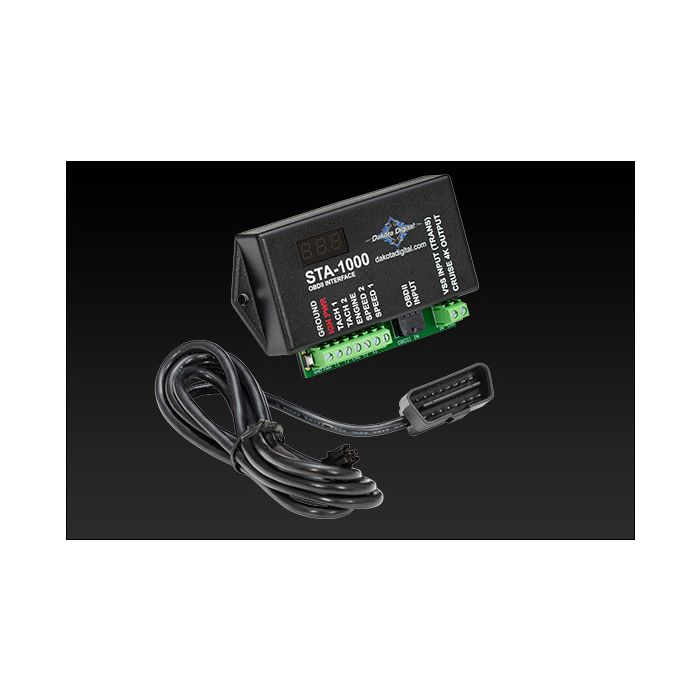

The Dakota Digital STA-1000: Late-Model Drivetrain integration has never been simpler!
Fully compatible with common aftermarket electronic speedometers
User selectable output of: 4k, 8k, 16k PPM signals, Sine or Square wave options
+/- 25 percent speed signal correction, compensating for tire size or gearing changes
Adjustable 4, 6 or 8 cylinder tachometer signal output
Check Engine light output provides a grounded (-) output to activate a check engine light of your choice
Automatically calibrated output for an aftermarket cruise control can be activated by making connection to the higher-resolution fixed VSS sensor
Small footprint measures 4-3/4"x 3"x 1" making it easy to hide


| year make model | GM 1996-up, Ford 1996-up, Chrysler 2000-up 2008 and all vehicles 2004–2008 |
|---|---|
| Manufacturer | DAKOTA DIGITAL |
| More Info | Compatible with J1850 and CAN OBDII protocols**
**Compatible with OBDII protocols SAE J1850 VPW, SAE J1850 PWM and ISO 15765 CAN 500k 11 bit identifiers that follow the SAE J1979 PID protocol. GM 1996-up OBD-II protocol Ford 1996-up OBD-II protocol some Chrysler 2000-up OBD-II protocol or SAE CAN OBD-II protocol CAN OBD-II is used on all vehicles 2008 and newer and some vehicles from 2004 – 2008 It provides: speedometer tachometer and engine indicator outputs. Do not mount this in the module in the engine compartment; it should be mounted in interior of the vehicle. Operation The RPM and speed can be provided by this unit instead of trying to find a compatible connection somewhere in the vehicle wiring harness. These outputs can be calibrated to match the gauge being connected. The malfunction indicator lamp (MIL) or service engine soon indicator will be activated from the data bus when there is an engine code set. This will not turn on the indicator for a lamp test function when the key is on, but the engine is not running. Since a cruise control will typically not work well with the speed data from the diagnostic bus, a connection is provided to connect a VSS signal directly from the transmission and then provide a calibrated 4000 ppm output. The output is self calibrated by reading the incoming transmission VSS signal and comparing it with the speed data from the diagnostic bus. |